


This week’s issue features guest expert Ashley Koff, RD, bestselling author of Your Best Shot.
Every Indian kitchen I have been in calls dal “protein.” I have been calling it that for years till I dug in further and looked at the macros.
To hit 30 grams of protein from cooked lentils, you need about 1¾ cups of cooked dal. That serving carries roughly 380 calories and 67 grams of carbohydrate. Just the lentils, no rice or roti.
Sure, the protein is there, but so are the carbs and a high amount of calories.
This issue is about that “everything else.” Vegetarians can get enough protein. It’s just harder than it is on a diet that includes animal-based sources. Plant sources are less protein-dense, and have a higher percentage of carbohydrates or fats. Their amino acid profiles are also less complete, though that matters less than most people think. In this issue, we dig into the details, look at various options, and offer a framework on how to choose between the different options.
TL;DR
Vegetarian diets can meet protein needs. The plate design is harder than on an animal-based diet mainly because plant sources are less dense, so more carbohydrate and fat ride along with each gram of protein.
Judge any protein source by two questions: is it complete (does it carry all nine essential amino acids?) and how dense is it (how much protein per calorie, before carbs and fat crowd the plate)? Completeness matters over the course of a day; density needs to be considered in every meal.
Those two answers sort every source into three roles: Anchors carry the meal (complete and dense), Bridges support it (dal, chana: real protein but carb-heavy), and Toppers garnish it (seeds, nuts: incomplete and calorie-dense).
Yes, vegetarians can hit the target
The evidence on whether vegetarian diets support muscle and protein needs has gotten cleaner in the last few years.
A 2023 RCT in young adults compared a high-protein vegan diet against a high-protein omnivorous diet over 10 weeks of progressive resistance training (Journal of Nutrition, 2023; n=22 in the training phase). Both groups gained lean mass at the same rate (+3.1 kg vegan, +2.6 kg omnivore), with comparable strength gains and identical daily muscle protein synthesis. A 2024 crossover trial in active older adults (average age 72) found the same: integrated daily muscle protein synthesis was identical on a 10-day vegan diet versus a matched omnivorous one, and the vegan diet also lowered LDL cholesterol (Journal of Nutrition, 2024; n=34). A South Asian-specific study found SA men gained the same muscle and lower-body strength from 12 weeks of strength training as White European men (Scientific Reports, 2022; n=34). The bodies respond. The plate has to deliver.
How much protein each meal needs to deliver depends on age. Older muscle is anabolically resistant: the same dose produces a smaller response, so the target per eating occasion rises with age, from about 0.24 g/kg in your 20s toward about 0.40 g/kg in older age (Moore et al., J Gerontol A Biol Sci Med Sci, 2015). In practical terms, that is 15 to 30 grams per eating occasion. This issue anchors on the top of that range, 30 grams, because it is calibrated for middle-aged readers, with room to scale to 35-40 g for those over 60 or training heavily. Landing protein in this window at each meal also blunts the post-meal glucose rise, a second reason to spread it across every meal rather than backloading it at dinner.
“My personal anecdotal experience has been that the sweet spot for me is in the 30-35g range.”
- Amandeep
What that 30 grams looks like depends entirely on the source. A dal plate and a bowl of Greek yogurt can both deliver it. They are not the same plate.
How to judge any protein source
There are two questions to ask when evaluating any protein source:
Is it complete?
How dense is it?
Completeness
Your body needs nine essential amino acids it cannot make on its own. A “complete” protein source delivers all nine in proportions adequate for human needs. Animal proteins (dairy, eggs, fish, meat) are almost always complete. Most plant proteins are not. Legumes (dal, chana, rajma) are usually low in methionine and cysteine. Grains (rice, wheat) are usually low in lysine. Soy is the exception: it carries all nine in adequate proportions on its own, which is why tofu and soy chunks behave more like dairy than like legumes.
Here is where an old rule needs retiring. Many of us were taught that you must combine beans and rice in the same meal to make a complete protein. That idea, popularized in the 1970s, was walked back decades ago, including by the writer who first spread it. Your body keeps a circulating pool of amino acids and draws on it across the day, so completeness is a property of your day, not your plate. As our guest expert Ashley Koff, RD, puts it: the amino acids stay available across a 24-hour window, so what matters is that the day adds up to a full set, not that any single meal does. Eat dal at lunch and a cup of dahi at breakfast and you have already covered the gaps that dal-and-rice was supposed to close at one sitting. For a vegetarian eating any reasonable variety, completeness mostly takes care of itself.
One thing genuinely is a per-meal question, and it is leucine, not completeness. Leucine is the amino acid that triggers muscle protein synthesis directly, with the response strongest at roughly 2.5 to 3 grams in a single sitting, near the top of the acute leucine dose the ISSN position stand (2017) recommends. Unlike total amino-acid coverage, which your body assembles from its pool across the day, the muscle-building trigger responds to the dose in a single sitting. A 30-gram serving from dairy, eggs, or whey clears it easily; the same amount from soy or legumes sits closer to 2.3 to 2.5 grams, just at the line. This is the real reason to put a dense, complete anchor on the plate, and it is a dose question, not a pairing one.
Incomplete is not a dead end, and there are ways to handle it.
Pair across the day. A legume and a grain cover each other’s gaps: dal is low in methionine and carries lysine, rice is the mirror image, and over a varied day the pairing happens without anyone planning it. Dal-chawal was solving this centuries before anyone studied protein completeness and scored different sources based on that (more below). The catch is doing it in one sitting: pairing fixes completeness, not the carbohydrate. Dal and rice is two carbohydrate sources stacked together, so the carb load climbs even as the amino acid profile fills out. That tension is the whole reason the South Asian plate runs the way it does.
Top it with a complete, lean anchor. A scoop of whey or a pea-and-rice blend, a spoon of dahi, a few cubes of paneer alongside the dal clears the leucine threshold and adds almost no carbohydrate. This is the move that raises a meal’s protein quality without piling on the carbs.
Supplement the limiting piece. For someone training hard and watching calories, free leucine or an essential-amino-acid powder hits the per-meal muscle trigger with no extra food. A precision tool, not an everyday requirement.
The FAO (the United Nations Food and Agriculture Organization) formalizes the completeness question with a score called DIAAS (digestible indispensable amino acid score), which captures both whether a source has all nine essential amino acids in adequate proportions and how much of it you can actually digest. Dairy, soy products, and eggs score “good” or “excellent”; lentils, chickpeas, kidney beans, wheat, white rice, and most seeds and nuts fall short on their own. In the table below, “complete” and “incomplete” stand in for those scores.
Density
Completeness is about amino-acid coverage. Density tells you how efficiently a source delivers: how much protein you get per calorie. This is the number that decides whether you can hit a protein target without a calorie flood, and it is the single most useful thing to know about a protein source. Greek yogurt hands you 30 grams of protein in 180 calories. Almonds, on the other hand, have 810 calories for the same 30 grams of protein. Same amount of protein, wildly different efficiency.
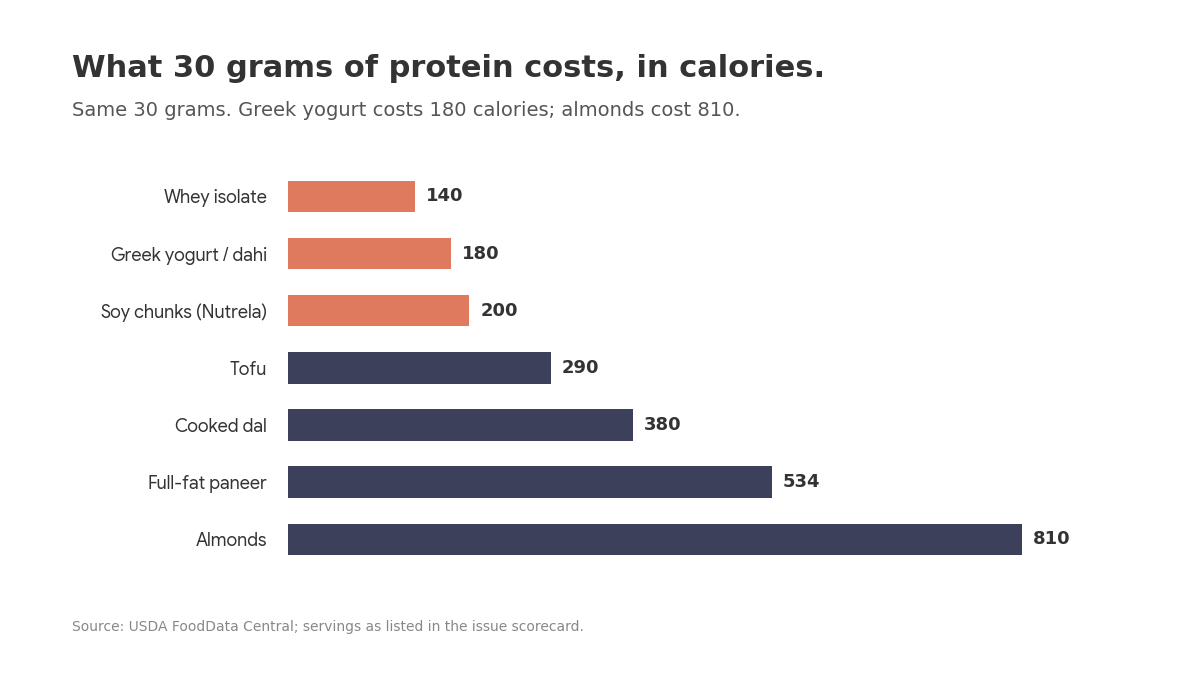
Density and completeness are independent, and that independence is what most vegetarian-diet advice misses. Full-fat paneer is complete but low-density: you pay for its protein in fat calories. Dal is incomplete and only moderately dense. A high quality score does not make a food an efficient protein, and a beloved staple is not automatically a lean one.
One more layer matters for a cardiometabolic reader: not just how many calories ride along, but what kind. Dal’s come as carbohydrate, which drives glucose and triglycerides. Full-fat paneer’s come as saturated fat, which drives ApoB and insulin resistance. The scorecard lists both so you can see which bill you are paying.
Three roles of a protein source
Put the two answers together and every protein source falls into one of three roles:
Anchors are complete and dense. They carry the protein in a meal: dahi or Greek yogurt, whey, eggs, soy chunks, tofu, low-fat paneer, a pea-and-rice blend. A few anchors are complete but low-density, like full-fat paneer: real protein, but you pay in calories and saturated fat.
Bridges are real protein but carb-heavy, eaten as a dish, and incomplete on their own: dal, chana, rajma. They support an anchor; they cannot replace one.
Toppers are incomplete and low-density, a lot of calories for the little protein they add: seeds and nuts. They garnish a plate; they never anchor it.
“In addition to these two important levers, another factor to consider is whether you actually absorb what you eat. Before adding more protein, make sure digestion is working, because protein you cannot break down does not help, and can add stress to the system. That is true for everyone, but it requires more intentional effort with a vegetarian plate. Digestion is the foundation I build every client’s plan on.”
- Ashley Koff, RD
The scorecard
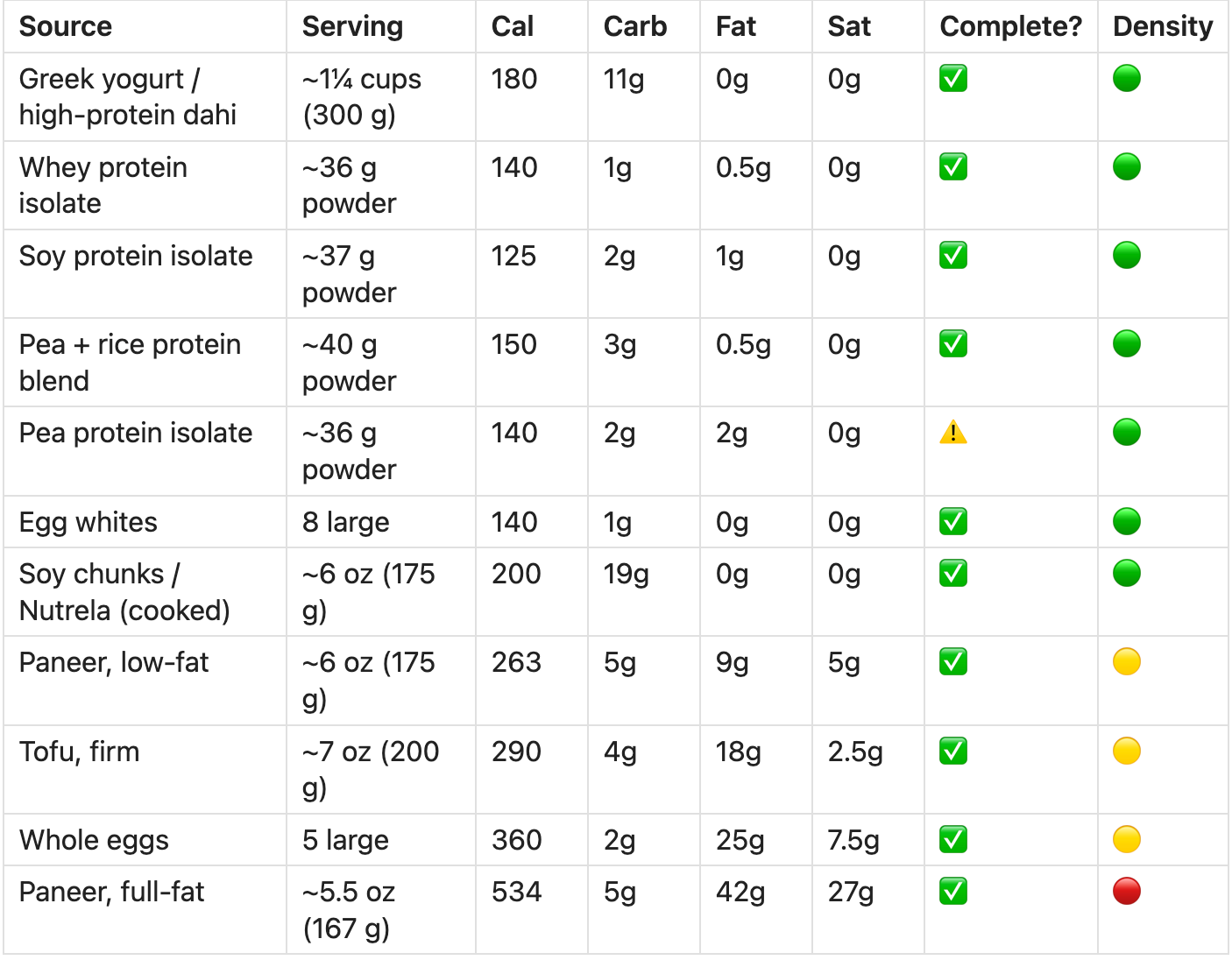
Here is every common vegetarian protein, scored on both questions and sorted into its role. For each, this is what it takes to reach 30 grams of protein, and what comes along for the ride.
Anchors (complete; they carry the meal)
Bridges (incomplete alone; real protein, ride alongside an anchor)

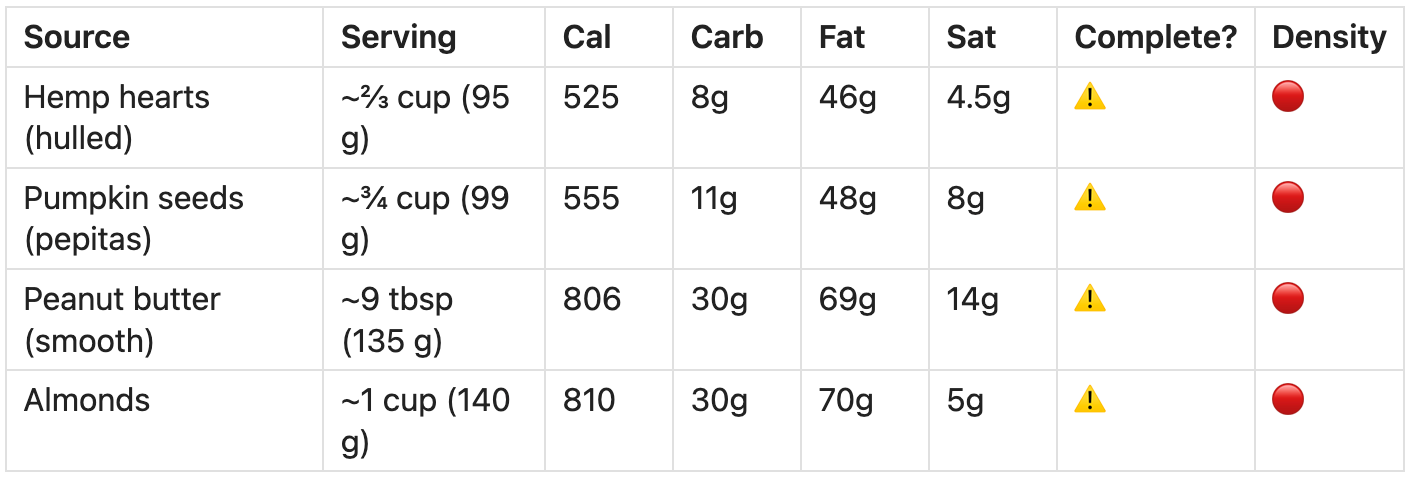
Toppers (incomplete; sprinkle, don’t rely)
A few things jump out.
The lean anchors do the most work for the least. Greek yogurt, whey, egg whites, and a well-designed plant blend each deliver 30 grams of protein for under 250 calories and under 15 grams of carbohydrate. If you are trying to hit a high-protein target without doubling a meal’s calorie or carb load, these are the tools. Soy chunks (often sold as Nutrela in Indian grocery aisles) belong right with them and are the most underused anchor in South Asian vegetarian cooking. Their one tradeoff is carbohydrate, and it is worth being precise about: because textured soy is made from defatted soy flour, it keeps more of the bean’s soluble carbs than tofu does, so the same 30 grams of protein arrives with roughly four times the carbohydrate of tofu (about 19 grams versus 5). Still modest, and far below dal.
Among the powders, the choice is mostly about source, not efficiency, since all of them are lean. Whey and soy isolate are complete proteins on their own. A pea-and-rice blend is complete by design, the rice supplying the methionine that pea is short on. Pea protein alone is the one to read the label on, because without that rice it stays low in methionine (the lone ⚠️ among the powders in the table).
Full-fat paneer is the cautionary anchor: complete protein, but 42 grams of fat and 27 grams of saturated fat for that 30 grams, more saturated fat than most days’ recommended limit in a single serving. Fine occasionally, expensive daily, and a real problem if your ApoB is climbing.
Then the bridges. Dal’s density is only moderate, and the real problem is what fills it out: you eat 67 grams of carbohydrate to get 30 grams of protein, roughly half a day’s budget before any rice or roti. By the macros, dal is a carbohydrate source that contains protein. Chana is worse (90 grams of carbohydrate for the same 30 grams of protein).
Seeds and nuts sit at the bottom as toppers. Hemp hearts are the closest to complete, but reaching 30 grams from any seed or nut costs 500 to 800 calories and 45 to 70 grams of fat. A tablespoon of hemp on dahi or a handful of pumpkin seeds adds protein and useful minerals; no one is building a meal’s protein around almonds.
A few caveats. The RCTs showing equivalent muscle adaptations are mostly short (10-12 weeks) and mostly in younger adults; long-term data in older vegetarians is thinner. The 30 g per-meal target is a mid-range calibration; heavier anabolic resistance may push it to 35-40 g. The DIAAS values for paneer are functional estimates, not formal assays, and seeds and nuts are marked incomplete rather than scored because published values are for protein isolates, not the whole food. The direction holds; the precision at the edges does not.
The anchor-first plate
A 100-gram protein day on a vegetarian plate is mostly a question of architecture, not new recipes. The rule is simple: an anchor at every meal, with bridges and toppers in support.
Breakfast. A cup of high-protein dahi (look for 15-17 g per cup and check the protein-to-carb ratio on the label) or a small protein smoothie is the easiest single move. No cooking change, no household disruption.
Lunch. A dal-and-vegetable plate with a real anchor on top: a side of tofu sabzi, a few cubes of paneer, two eggs if you eat them, or a generous bowl of plain Greek yogurt alongside. The dal stays as the bridge; the anchor sits next to it.
Dinner. A protein anchor (paneer, tofu, soy chunks, or eggs) plus dal plus vegetables plus a measured carbohydrate. The carbohydrate becomes the smaller player on the plate, not the largest.
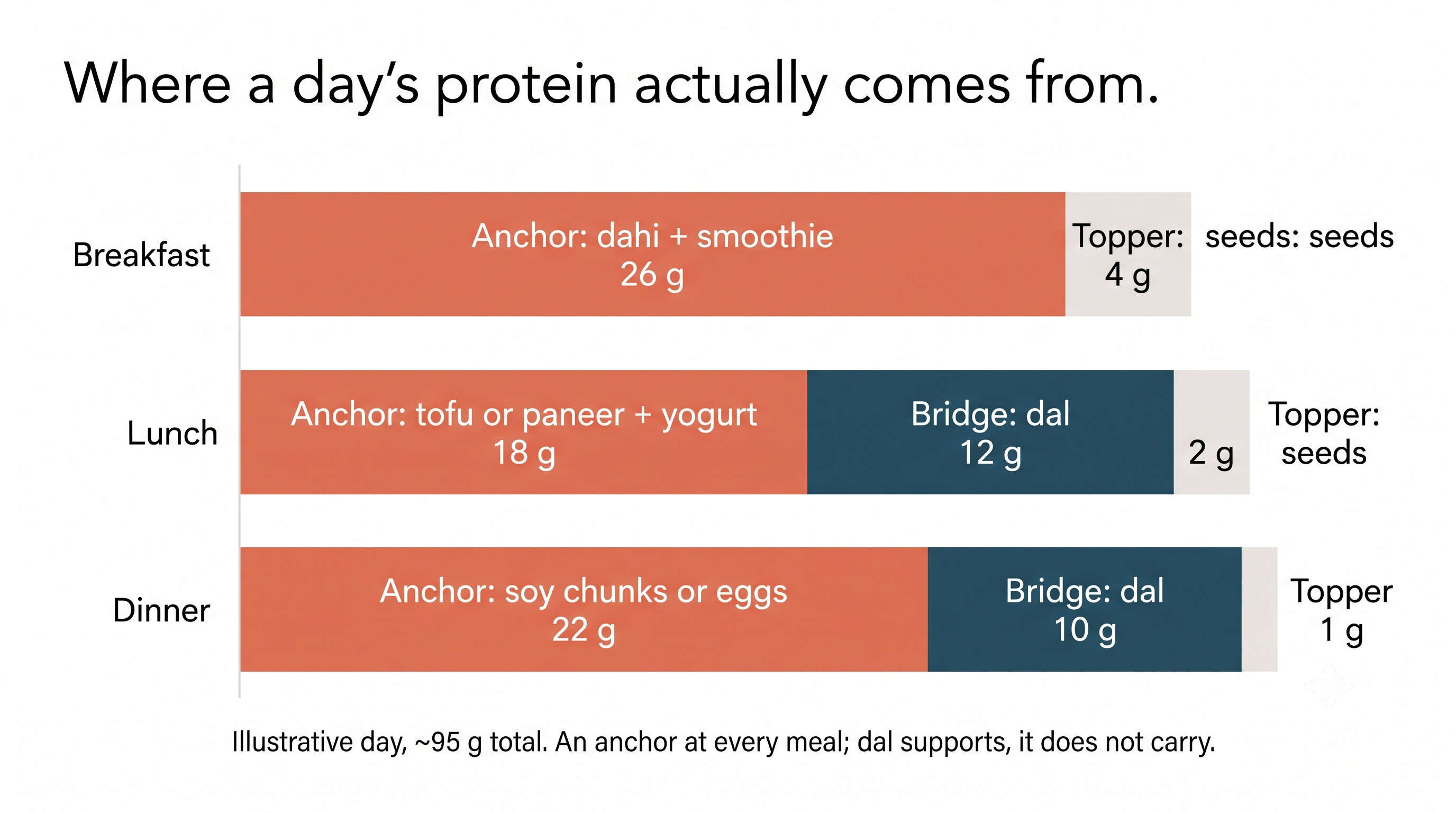
That sequence assembles roughly 90 to 110 grams of protein across three meals, which lands in the 1.2-1.6 g/kg range for most adult readers.
“Many of my vegetarian clients, especially those who grew up on a dal-and-rice plate, are eating a lot of dal and assuming that means protein is covered. When we run their actual numbers, it almost never adds up. The fix is anchor-first meal planning: a namable protein source at every meal, not just dal. Once we move from ‘protein is in there somewhere’ to ‘protein is on the plate I can name,’ the rest of the diet usually starts to fall into place. Body composition, energy, satiety, all of it.”
- Ashley Koff, RD
Myth: “Dal is high in protein”
The Myth: Indian households have called dal “protein” for generations. Reddit threads, family WhatsApps, and primary care doctors repeat it. If you eat dal regularly, the assumption is that the protein box is checked.
The Evidence: The scorecard above settles it. By the macros, dal is a carbohydrate that carries some protein, not a protein source, once you see the carb load it takes to reach 30 grams. Its quality is modest too: on DIAAS, dairy, soy products, and eggs clear the FAO “good” threshold; lentils, chickpeas, and kidney beans do not.
Dal is a bridge, not an anchor. It is real protein and a useful support food in a well-designed plate, but the anchor has to come from somewhere else.
Questions you’re probably asking
“I always eat dal with rice because I was told the combination makes a complete protein. But my triglycerides keep climbing. Am I doing something wrong?”
First, the good news: you can stop worrying about the completeness part. The rule that you must pair beans and rice to build a complete protein has been retired. Your body keeps a pool of amino acids and draws on it across the day, so a varied vegetarian diet covers the gaps on its own. You were never at risk of an incomplete plate. What the pairing does do is stack two carbohydrate sources together, and that is where the triglycerides come in. A dal-rice-roti plate is carbohydrate-dominant, and in insulin-resistant South Asians a carbohydrate-heavy meal pushes the liver to make more VLDL, the particle that ferries triglycerides into your bloodstream. That is the climb showing up on your panel, and a normal protein total does nothing to flag it. The fix is not to give up the flavors. It is to let the protein come from a lean anchor at each meal and let the carbohydrate be the smaller player. The carbohydrate load, and the triglycerides, come down with it.
“I have been vegetarian my whole life and just started lifting. I eat plenty of dal, but I am not gaining strength the way my gym friends are. Is it the diet?”
Usually a per-meal leucine gap, not a total-protein problem. A dal-anchored meal often falls short of the leucine dose that flips the muscle-building switch. The fix is not more dal. It is a leucine-rich anchor at each meal: high-protein dahi, soy chunks, paneer, eggs, or a scoop of whey or plant blend. The other lever, creatine, gets its own note just below. Same training, different plate.
“I aim for a protein anchor at every meal, even if I don’t always hit it. Greek yogurt and lentils show up in my own diet often. I eat eggs, and I don’t love eating meat every day. The simplest move on my own plate has been keeping a tub of high-protein dahi (roughly 17 g of protein per cup) in the fridge as a default add-on at lunch and dinner. No recipe change, no cooking change, just a cup on the side that pushes the meal from around 12 g of protein to closer to 30. My kids drink flavored Greek yogurt where the protein-to-carb ratio is usually good once you read the label, and we pay attention to that ratio across the household.”
- Amandeep
Vegetarians have options beyond dal. One just has to be deliberate about how to construct the plate, and use data to inform your approach.
Ask Your Doctor About: Creatine
If you are a lifelong vegetarian who lifts, this is the one supplement with a clear, specific payoff. Creatine comes almost entirely from animal foods, so vegetarians carry lower muscle creatine stores to begin with, and in a controlled trial they gained more lean mass from creatine plus resistance training than omnivores on the same protocol (Burke et al., Medicine & Science in Sports & Exercise, 2003). Five grams a day of creatine monohydrate is the standard maintenance dose and a sensible floor; larger bodies and heavier training loads often do better on more. Cheap, well-studied, and the clearest vegetarian win in this whole issue.
Disclaimer: The information provided in this article is for educational and informational purposes only. It is not intended as a substitute for professional medical advice, diagnosis, or treatment. Always seek the advice of your physician or other qualified healthcare providers with any questions you may have regarding a medical condition or wellness program. Reliance on any information provided in this article is solely at your own risk. The author and publisher of this article make no representations or warranties, express or implied, regarding the completeness, accuracy, reliability, suitability, or effectiveness of the information contained herein. The inclusion of specific products, services, or strategies in this article does not imply endorsement or recommendation. The author and publisher disclaim any liability for any adverse effects or consequences resulting from the use or application of the information presented. You are encouraged to consult with a qualified healthcare professional before making any changes to your diet, exercise routine, or lifestyle.
Thank you for your publication. All the articles are excellent and very helpful.