


This week’s issue is co-authored with Trei Tackett, MSN, FNP, executive health coach and founder of Pillars Health.
When people say “strength training,” they usually lump together three different goals: getting stronger, getting bigger, and building endurance. They sound like one thing. In reality, they’re trained differently, and for your health they aren’t equally worth your time.
The difference matters more as you age. You have to be a lot more focused, and you have to make sure you recover well. In this post, we get into the details of the goals, offer a perspective on which ones actually move the needle, and show how to build a week around them.
TL;DR
Resistance training builds three things: strength (force), hypertrophy (size), and endurance (fatigue resistance). They’re trained with different loads, but effort matters more than the exact rep number.
For metabolic health, hypertrophy is the priority. Muscle is your largest glucose sink, and building it barely depends on the “right” rep range, just hard sets.
After 40, add strength and power (for function, balance, and avoiding falls) and some heavier, higher-impact loading (for bone). Endurance is the least essential of the three.
The week is simpler than it sounds: two or three short sessions, most sets 1 to 3 reps short of failure, and a heavier or faster day once you’re past 40.
Three goals, trained three ways
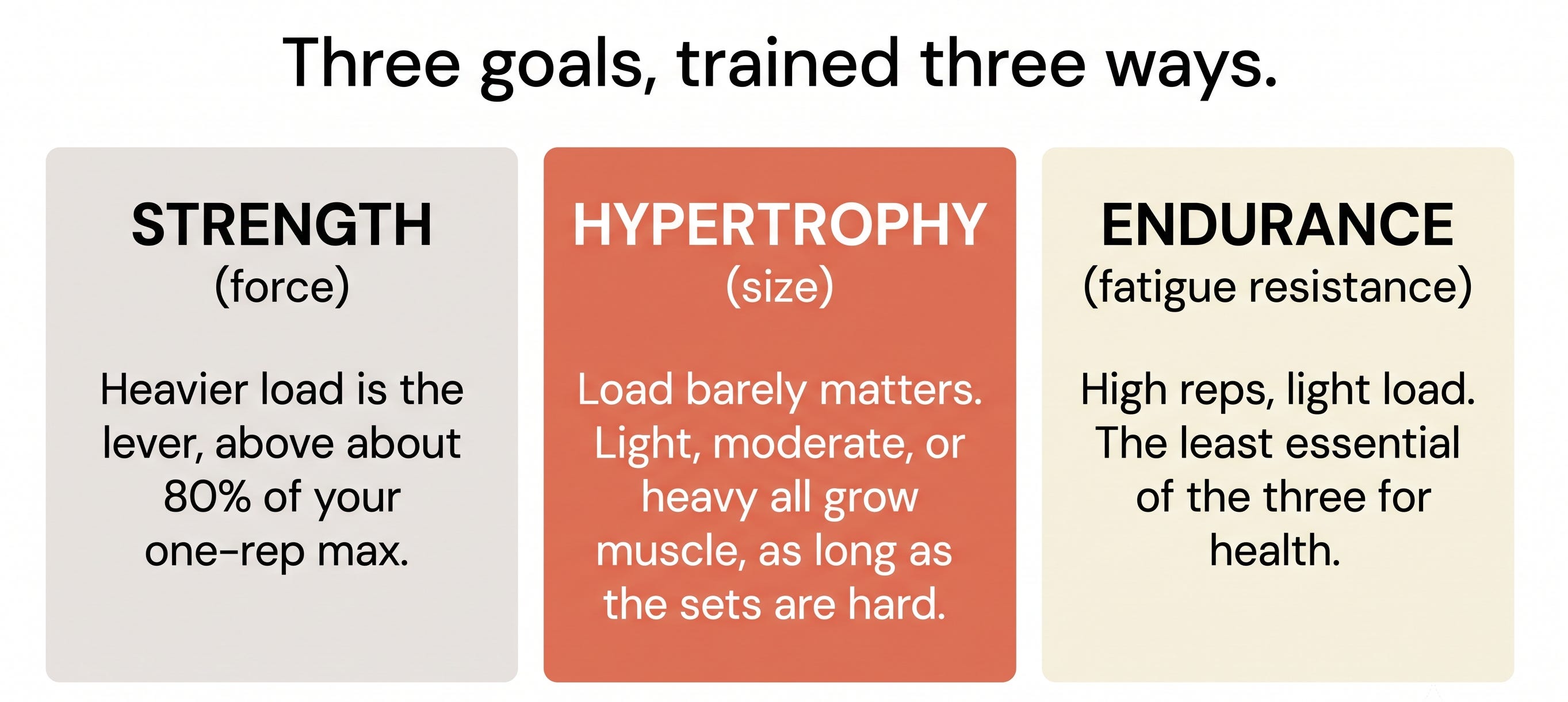
Resistance training builds three distinct qualities. Strength is how much force you can produce. Hypertrophy is the muscle physically getting bigger. Local muscular endurance is how long a muscle can keep working before it fatigues.
One nuance sits inside strength. Power is how fast you can produce force, the speed layered on top of raw strength: a powerlifter grinding out a heavy deadlift is expressing strength, while a sprinter exploding out of the blocks is expressing power. Most people don’t train the two separately, which is why the classic gym chart lists three, not four. That chart assigns each a rep range: low reps for strength and power, moderate for size, high for endurance (Schoenfeld et al., Sports, 2021; a review re-examining that “repetition continuum”). It’s a useful starting point, and looser than it looks.
Here’s what the strongest evidence shows. For raw strength, load is the lever: heavier weights, above about 80% of your one-rep max, produce the biggest gains. For size, the load barely matters. Light, moderate, and heavy all grow muscle to a similar degree, as long as the sets are hard (Currier et al., British Journal of Sports Medicine, 2023; 178 strength studies with 5,097 people, and 119 muscle-size studies with 3,364). An earlier review found the same: taken close to failure, light and heavy loads built muscle about equally (Schoenfeld et al., Journal of Strength and Conditioning Research, 2017; 21 studies).
What ties them together is effort, not the rep count. The useful gauge is reps in reserve, which means how many more you could have done. You don’t need to grind to failure. Stopping 1 to 3 reps short captures nearly all the muscle growth (Refalo et al., Sports Medicine, 2023; systematic review and meta-analysis). Going closer to failure does nothing extra for strength (Robinson et al., Sports Medicine, 2024; meta-analysis, 55 hypertrophy and 67 strength studies), but it does raise the injury risk.
What your metabolism needs, and what changes with age
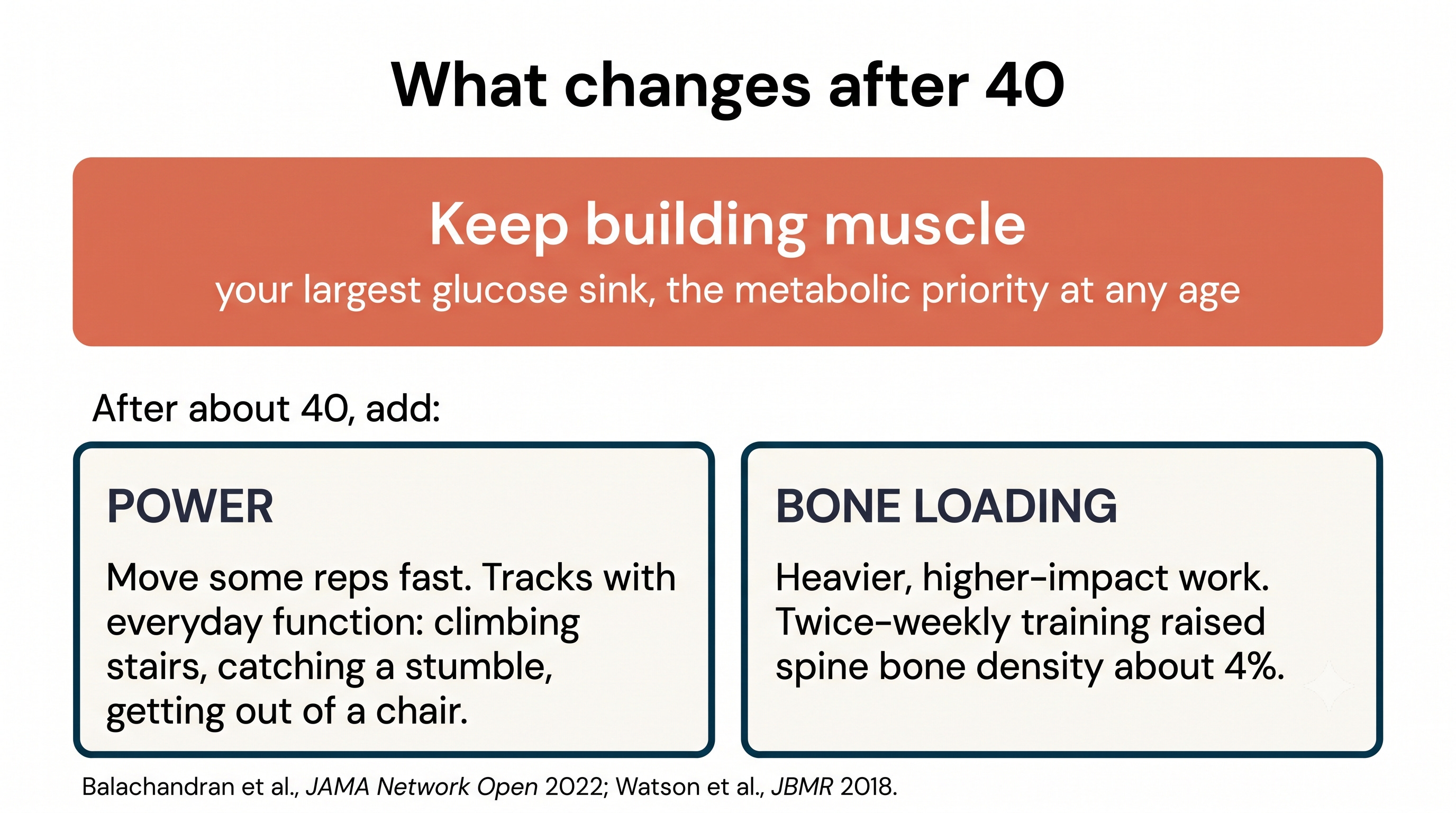
Building muscle is the metabolic priority, because muscle is your largest glucose sink. Most of the sugar in your blood gets cleared into it, so more muscle is better for metabolic health. We walked through that mechanism in our training week issue. The form of training that matters most for your metabolism is hypertrophy, and because size responds to hard sets across a wide rep range, you don’t need a perfect rep number to get it. This matters most for people who look fine on the scale but carry the thin-fat pattern, common in South Asians, where a normal weight can hide too little muscle.
After about 40, two more things start to count: power and bone density. Power, the ability to produce force quickly, fades faster than raw strength and tracks more closely with everyday function, whether you can climb stairs, catch a stumble, or get out of a chair. Training that moved weights quickly was associated with a modest improvement in physical function in older adults compared with slower strength work (Balachandran et al., JAMA Network Open, 2022; systematic review and meta-analysis).
Bone responds to heavier, higher-impact loading. In postmenopausal women with low bone mass, twice-weekly high-intensity resistance and impact training raised lumbar-spine bone density by about 4% while a gentler program did not (Watson et al., Journal of Bone and Mineral Research, 2018; randomized controlled trial, n=101). That kind of training has to be coached and built up gradually. The trial stayed safe precisely because it was supervised and progressive.
That leaves endurance. High-rep, light-load work builds a muscle’s resistance to fatigue, which is useful if you enjoy it, but it’s the least essential of the three for staying metabolically healthy and independent.
How to build a week around it
Putting it together is simple. The Best Training Week Is the One You Repeat issue laid out the full picture: two or three strength sessions, some easy cardio, a daily walk. Here’s how to spend the strength part so it covers what matters.
On each strength day, work the major muscle groups, push, pull, hinge, and squat, in a range that’s genuinely challenging, roughly 6 to 12 reps, with most sets stopped 1 to 3 reps short of failure. That one choice covers hypertrophy and a good share of strength at the same time. Let the weights climb over the months. That progression is the signal your body actually responds to.
If you’re past 40, add two small things. One heavier day, where you drop to about 5 or 6 hard reps on the main lifts, builds strength and loads the bone. And a few fast, controlled reps, moving the weight with intent, train power. Neither needs its own session; they fold into the days you already have.
You can skip dedicated endurance work. High-rep burnout sets aren’t where your health payoff is, and the challenging sets you’re already doing build plenty of staying power.
A simple check that a session counted: the last couple of reps of each set were hard, your form held, and you’re lifting a little more than you were a few months ago.
In practice, nobody needs three separate programs. When I take on a client, the first thing we settle is whether they’d rather train four shorter days a week or three slightly longer ones. It matters less than people think. When weekly volume is matched, three and four days produce comparable muscle growth (Pelland et al., Sports Medicine, 2026; meta-regression). What actually drives growth is total weekly volume and hitting each muscle group at least twice a week. The extra day is about logistics, not physiology: it lets you spread the work out so you’re not stuck doing hour-long marathon sessions. And honestly, that’s often what decides whether someone sticks with it. If an hour in the gym feels daunting, I’d much rather see a client train 30 or 40 minutes, four times a week.
Most of what I give clients is that same simple structure. As they get comfortable and the weights climb, I add a little heavier work, and some faster, powerful movement and light impact as they get older, for the bones and the reflexes. The last set or two is where they get close to failure. That’s the whole recipe.
- Trei
The three forms aren’t a test you have to ace. For your health, the order is important: build muscle first, your metabolic engine; keep strength and power as you age, your independence; treat endurance as a bonus, not a goal. Get that order right, push your sets close enough to count, and the exact rep range you used to get there stops being a question worth asking.
If you want one structure to start with, pick a weight you can lift about 8 to 12 times before your form breaks, and stop each set 1 to 3 reps before that point. A good sign you’ve chosen the right weight: your first set ends near the top of the range, around 12 reps, and by the third or fourth set, with 60 to 90 seconds of rest between them, you’re stopping two or three reps earlier, around 9. Hit the major movements twice a week. Once it feels routine, add one heavier day at 5 or 6 hard reps, plus a few fast, controlled reps to train power. When you go heavier, I prefer single-leg work: a reverse lunge with dumbbells loads one leg hard while sidestepping the risks and form breakdowns of a heavy back squat. That covers muscle, strength, and bone, no chart required.
- Trei
Disclaimer: The information provided in this article is for educational and informational purposes only. It is not intended as a substitute for professional medical advice, diagnosis, or treatment. Always seek the advice of your physician or other qualified healthcare providers with any questions you may have regarding a medical condition or wellness program. Reliance on any information provided in this article is solely at your own risk. The author and publisher of this article make no representations or warranties, express or implied, regarding the completeness, accuracy, reliability, suitability, or effectiveness of the information contained herein. The inclusion of specific products, services, or strategies in this article does not imply endorsement or recommendation. The author and publisher disclaim any liability for any adverse effects or consequences resulting from the use or application of the information presented. You are encouraged to consult with a qualified healthcare professional before making any changes to your diet, exercise routine, or lifestyle.